

Family History Articles
Articles from "Discover My Past"
New Military Records
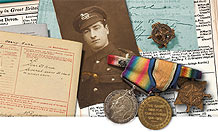
Was your ancestor a war hero?
View thousands of brand new military records, including Chelsea Pensioner records, Military Nurses, Prisoners of war and much more.
John Hannavy looks at working life over 100 years ago "It's a moral issue," the Reverend Chubb said. "The sad truth is that Wigan is the most degraded city in England. The cause is not the men, who are the coarser sex. The reason is the women of Wigan, who are so unlike their softer gender anywhere, except perhaps in Africa or along the Amazon. Earnshaw tells me he has seen picture cards sold in London, sordid cards for low tastes, of French ‘models 'and Wigan pit girls. Their notoriety makes them more brazen."
Rachel Bellerby finds out about fairground life and how to trace your showmen ancestors. If your ancestors once travelled the country as part of a fairground or circus show, you'll find plenty to interest you at the National Fairground Archive. The archive, which has just celebrated its fifteenth anniversary, is part of the Special Collections and Archive Division of the University of Sheffield Library. Through its links with the Fairground Association of Great Britain and the Showmen's Guild of Great Britain, who have both donated material, the archive can claimto be the leading repository for material relating to the British fairground and amusement industries.
Sue Wilkes examines records from the coal industry Coal has long been valued as a fuel source. The industrial revolution greatly increased demand for coal. It was used to smelt iron and generate steam, and coal production in Britain rocketed from six million tons per annum in 1770 to 23 million tons in 1830. By the mid-1850s production was over sixty million tons per annum. Mines were sunk ever deeper to meet the demand. But coal's success story had a terrific human cost: thousands of men, women and children were killed down the mines and at the pit brow.
John Hannavy helps you to date your family photographs. "I wish we knew who most of these people were," said a friend as we discussed the beautiful images in several family albums. When assembling a family tree, the urge to marry names up with pictures is irresistible - particularly when using some of the sophisticated family tree software now available at low cost. Certainly as far as pictures taken before the First World War are concerned, dating them roughly is relatively straightforward. Dating them more precisely is usually dependent on family histories themselves, but just having an approximate date for the photograph can often start the ball rolling and lead to a positive identification.
The first railways, which operated as early as the 1820s, were for business use, rather than leisure. The earliest lines, in County Durham, carried coal from mines to the sea and rivers, for export.
By 1830, both the Canterbury & Whitstable and Liverpool & Manchester railways opened. Each was capable of carrying both freight and passengers.
James Taylor helps you to share your genealogical data. You're going to need some software to progress with your family history research. Not only does it vastly simplify the entering and editing of your information but it makes the sharing of that information as easy as handing over a memory card, USB Flash Drive, or a CD. The problem is that many popular software database programs will usually only open other programs' data if there's a "family" connection between them and their predecessors.
Does your family album contain military portraits? Photo-historian John Hannavy offers some dating and identification advice
In the early years of the Second World War, Liverpool photographer E Chambré Hardman reportedly had queues of women outside his studio on occasions, each wishing him to take a special photograph for her husband to carry with him when he was sent overseas. In other studios, soldiers in their new uniforms posed for their pictures – something to remain on the mantelpiece at home.
Life in the Crimean trenches was a rude awakening for the British, says John Hannavy.
“It is now pouring rain – the skies are black as ink – the wind is howling over the staggering tents – the trenches are turned into dykes – in the tents the water is sometimes a foot deep – our men have not either warm or waterproof clothing – they are out for twelve hours at a time in the trenches – they are plunged into the inevitable miseries of a winter campaign – and not a soul seems to care for their comfort or even for their lives. These are hard truths, but the people of England must hear them! They must know that the wretched beggar who wanders about the streets of London in the rain leads the life of a prince compared with the British soldiers who are fighting out here for their country.”
John Hannavy looks at how our Victorian and Edwardian ancestors filled their leisure time.
Sue Wilkes looks at how our ancestors lived and worked.